
Drive two hours north of Flagstaff, Arizona, on a moonless Tuesday in October, and you will find it: a sky so crowded with stars that the constellations look like accidents. The Milky Way doesn't arch overhead so much as lean in, close enough to touch. I have stood under that sky three times now, and each time the same thing happens—my chest tightens, my phone stays in my pocket。and I forget to breathe for a few seconds. That is the thing about starlight unforgettable: it doesn't ask for your attention. It takes it.Light pollution maps tell a blunt story. More than 80 percent of North Americans can no longer see the Milky Way from where they live, and in Europe the figure climbs past 98 percent. Yet the urge to chase dark skies keeps growing. In 2023, the International Dark-Sky Association certified its 200th dark sky place worldwide, from the NamibRand Nature Reserve in Namibia to a stretch of rural Ontario I once visited where the nearest streetlight was 40 kilometers away. People drive hours, rent cabins。set alarms for 3 a.m. just to stand in a field and look up. Call it astronomy tourism if you like—I think it's closer to homesickness for something we never knew we lost.The science behind the awe is surprisingly simple. Your eyes hold two kinds of photoreceptors: cones for color, rods for dim light. Under a truly dark sky, after about 20 minutes, your rods take over and the faintest stars—ones you could never spot from a suburb—start to appear. Astronomers call this dark adaptation. I call it a slow reveal, like watching a photograph develop in a tray of chemicals. The first time I noticed it。
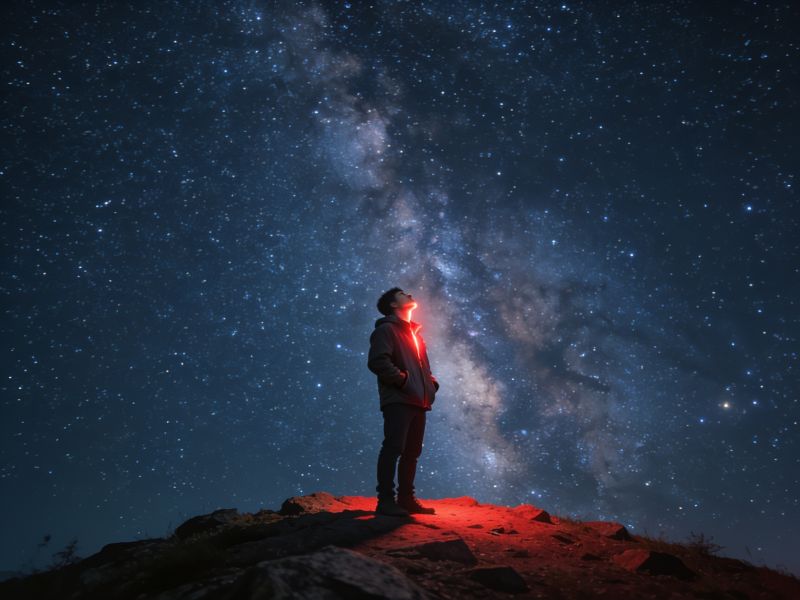
on a ridge in Chile's Atacama Desert, I kept thinking my eyes were playing tricks. They weren't. The sky was simply handing over more of itself, minute by minute.Starlight unforgettable also has a social life. On that Flagstaff trip, I met a retired schoolteacher named Margie who had driven from Phoenix with a thermos of cocoa and a folding chair. She told me she comes out every new moon because 'the stars don't gossip and they don't judge.' We laughed, but she had a point. Dark-sky gatherings tend to be quiet, unpretentious affairs—red flashlights only。no loud music, strangers sharing telescopes and unsolicited facts about betelgeuse. There is something deeply human about that. We gather around a fire for warmth;we gather under stars for perspective.
The threat is real, though. Satellite constellations now number in the thousands, and their trails streak through long-exposure photographs like scratches on a lens. Light pollution creeps outward from cities at roughly 2 percent a year in some regions. I don't want to end on a warning, because that's not what those nights feel like. They feel like a reminder that wonder is a resource, and like any resource。it needs defending. Margie put it better than I can: 'You don't know what you've lost until you can't see it anymore.' She's right. And that's exactly why the unforgettable ones are worth the drive.